
Comex III the Expedition
The Expedition by Liz Y
Comex was born of the dreams and hopes of those who had lived through some of the long struggles against colonial rule and the brutal
conflicts of two world wars. Many people from the generations, which preceded ours, were determined to promote a better, more peaceful
world for the young people of the future.
Comex itself was based on the visionary ideas of India's first Prime Minister Jawaharlal Nehru and British retired Colonel Lionel Gregory,
later to become known to us as Greg. Greg had experienced the traumas of war at first hand, having served with the Gurkhas during the
Malayan War and in Burma during WW2. He had a special love of India where he had lived as a child.
In accord with his personal friendship with Nehru, Greg wanted to see a future in which barriers of culture, religion, race and inequality
had no place. By bringing young people together from across the globe, Nehru and Greg hoped to create a world in which there would be
greater mutual understanding, friendship and peaceful co-operation amongst people of all nations.
It was Nehru's idea to build a centre in Simla as a focal meeting point for young people of the Commonwealth. Sadly Nehru died in 1964.
Although the centre was never built, Greg pursued an ambitious plan to create what he called "an army for peace". His idea was to organise
a series of expeditions in which young people from around the world would travel overland to India. Young people from the Asian subcontinent
and elsewhere would in turn travel to other parts of the Commonwealth.
On their travels Comexers would learn comradely skills of mutual reliance and co-operation and meet people of many different cultures and
ways of life. In each country, they would present formal and informal cultural performances of music, song, dance and drama in front of
audiences from host universities and other institutions, including local dignitaries and sometimes senior government representatives.
Indian President V. V. Giri gave a welcome address to Comex 3 in Delhi in 1969.
Although the particular focus of Comex was on the countries of the Commonwealth and the English-speaking world, the aims reached far beyond
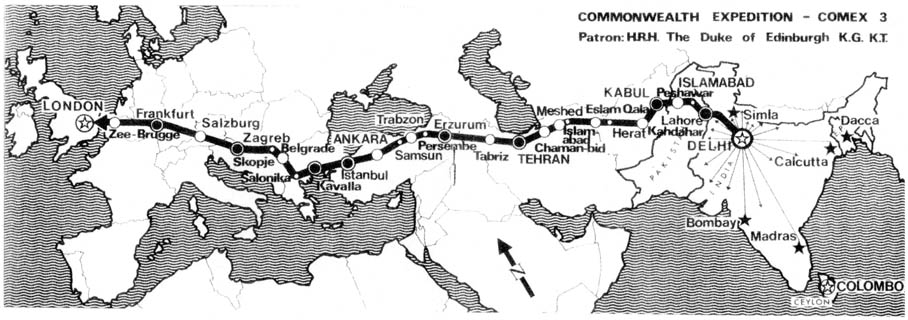
this. Ours was the third and largest Comex expedition and we travelled through ten countries, only two of which were in the Commonwealth.
We were welcomed in all of these places.
There were 500 of us on Comex 3, travelling in 20 small coaches. Students from universities and colleges all over the UK took part. Other
participants included young teachers, journalists, police cadets, nurses and at least one young doctor. Our ages ranged between 19 and 24
years. We were attracted by the prospect of visiting so many wonderful places and the challenge of a journey overland through distant deserts
and mountain ranges. All Comexers knew that it would take stamina and determination to live for three months, eating and sleeping outdoors
in hot, dusty and humid climates. It was a challenge of a lifetime and a journey we would never forget.
It may seem today that the world is as divided as ever, when we see the devastation of war in so many countries. On Comex, we learned that
there is another way and that hopes for peace, friendship and understanding should never be abandoned. In the words of an ancient text engraved
in the entrance hall of the Parliament of India, "the world is a family".